Paris Brest Paris 2011 report
- Running
- Sports articles
- Publications Cycling
The Paris Brest Paris ride, the story of three days and two nights of cycling.
The Paris-Brest-Paris ride
After a summer of 12,000 km of preparation, the time for departure is approaching. It's Monday, August 22nd, 5:20 a.m. and the second group of 400 competitors departs from Rond Point des Saules in Saint Quentin. To celebrate the event, the rain started to fall. I leave my cycling colleagues who came to see the start, as well as the accompanying coach whom I will meet again in Mortagne, the location of the next supply point.
The calm departure on Monday

The pace of the first few kilometers is regulated by an organization vehicle, so we leave the city calmly and dive into Ergal, Jouars, Montfort l'Amaury. The rapid descents are a precursor to the climbs to come on the way back. The peloton is not going too fast, but before the second half of the course, it splits into several groups. It must be said that the course is not flat and the climbs of Longny and Saint Mard are a true test. At 9:20 a.m., after 140 km, Mortagne is there and the average speed is 28 km/h, which is certainly quite high. Twenty minutes later, we depart for Villaines-la-Juhel, after ingesting a portion of pasta, filling our water bottles, and stocking up on solid food for the road. This same ritual will be repeated at each checkpoint/supply point with Christian, my companion, who efficiently takes on the roles of supply manager, mechanic, photographer, manager of good humor and morale: a highly valuable support.
In the statistics, it is said that an accompanied rider has less chance of reaching Paris because they are more tempted to get into the car if the riding conditions deteriorate. But in the field, I can say that the companion is a guarantee of success because they become a motivation, and for my part, I do not want to disappoint them. And the more he takes care of the success of the project in the field, the more the desire to do well grows during the ride.
The weather is beautiful, Christian asks me if I am taking my raincoat, I say "no, it's not going to rain," and on the sidewalk next to me, a woman says loudly "He doesn't know Normandy."
Rain in Villaines-la-Juhel
When I arrive in Villaines-la-Juhel, there is no companion waiting for me. Christian is waiting for me in Fougères, which is one checkpoint out of two. This allows me to manage Paris-Brest-Paris not as a 1,200 km ride, which is too big, too enormous to fit into a small human mind, but as a series of 150 km, each of which is further divided by the checkpoints in towns. In Villaines-la-Juhel, I just need to have my route card stamped and head towards Fougères. This second stage was still fast, overtaken by Americans, but with whom I was able to draft for some time. PBP is such that groups form and dissolve with the moods and the hills. Oh, I forgot, it's raining!
 At 5:25 pm, I meet Christian in Fougères, who has prepared rice for me, a nice change from pasta. I take the opportunity to change my jersey, put on my raincoat, slip on arm warmers, and keep my damp cycling shorts on.
The sky is getting very stormy to the point that when I leave the checkpoint, a downpour starts. The sky is black, lightning flashes, thunder roars, and we're not even in Brest yet. Fifteen minutes later, it is still raining, but the intensity has decreased, and I hit the road to Tinteniac, hoping that...
Thunderstorm in Tinténiac
A few kilometers later, the road is dry, which is a good sign for what's to come. The wind blows at my back, where there are black clouds. Halfway through, a secret checkpoint stops my progress. It's a secret control, but it's super organized with refreshments, checkpoint tables, security, and a structure to accommodate the 5,000 PBP cyclists. I ride with a cyclist from Poland who pedals well and shifts gears at the slightest hill. The speed varies accordingly, but the pedaling rhythm is almost constant. We arrive together in Tinténiac after taking turns at the front without even speaking. When we arrive at the checkpoint, we exchange a thankful look.
I get my cards stamped, and when I'm about to leave, the storm that broke out in Fougères catches up with us and pours its overflow of water. During this short quarter of an hour of rain, I take shelter in the hall of the dorms. A Japanese cyclist arrives and rents a bed for 5 euros and asks to be woken up at 7:00 a.m. the next day, even though it is already 8 p.m. At the sight of his green frame plate, this cyclist left on Sunday night.
Sleeping in Loudéac or Carhaix
87 km is the distance left for me to travel to get to Loudéac and have a meal. I ride alone for part of the way and in a group for the rest. I don't know whether I'll sleep in Loudéac or Carhaix, but I know I'll sleep for 2 hours. Carhaix is a good place to stop because it comes after one of the toughest stages, with some roads so demoralizing that it's better to ride them at night.
I arrive in Carhaix at 5:00 a.m. after a difficult but accomplished 77 km. Christian offers me 2 hours of sleep in his improvised bed in his car. Sleep comes, but not dreams. For the second consecutive night, I sleep in fits and starts, my eyes itch, and my legs seem tired. When the alarm goes off, it means it's time to get up, get dressed, and have breakfast, which will take an hour.
Brest, the end of the dream
On my way to Brest. Paradoxically, despite only having two hours of sleep, my legs feel good. The day is going to be long. I catch up to two Austrians on the way and ride with them for a bit. They often talk to each other and don't seem to appreciate my presence, one of them often looks back at me as I take turns. After a while, one of the two comrades comes up to me, says "It's good" and signals me to fall back into their wheels. I stay with them for a moment and finally go ahead to ride alone, I won't see them again.
At a crossroads, the road starts to climb towards Sizun, 18 km away, with the Trévezel rock at the top. The weather is thick fog, which is a change from yesterday's rain.
After the descent and on the way to Plougastel, a cyclist from Sweden takes my wheel and every minute freewheels for 10 seconds. I invite him to take a turn, but nothing. I gradually increase my pace, he stays hooked, I slow down, he stays behind, I ride normally, he still follows me with his freewheel becoming increasingly annoying. Finally, I slow down so much that at one point, he overtakes me and finally starts riding. I take advantage of a bump to find myself alone again.
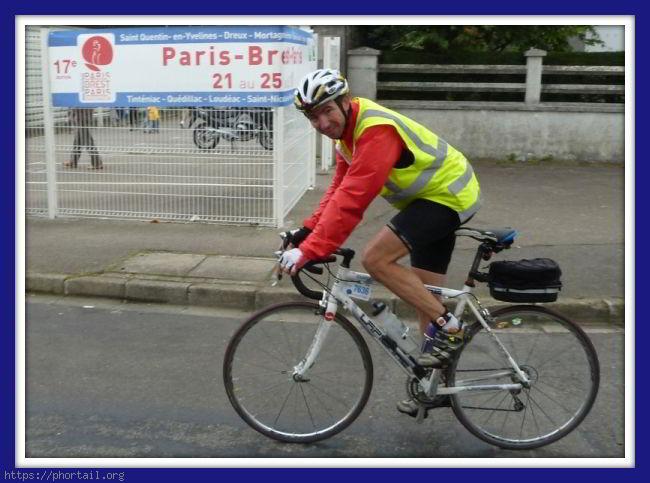 Brest is reached at 11:30 am, after discovering the Albert Louppe Bridge, the port, and the road that goes up to the checkpoint location. 30 minutes later, I hit the road back to Paris, starting with a return to Carhaix. Brest was reached in 30 hours with 2 hours of sleep, but how am I going to ride now? Will I have averages of 27 like on the way there? I have no doubts and decide to ride as best as possible, because in fact, both physically and mentally, everything is fine.
Smiling in Loudéac
Going to Carhaix means taking the road back to Sizun with its 18 km long hill. I take it patiently and roll as smoothly as possible, managing my rhythm, no standing climbs, it consumes too much energy, managing descents at the fastest pace, I ride alone but that means I ride at my own pace and if I listen to my feelings they are rather good. The more I ride, the better I feel.
In Loudéac, I smile because the stage had more descents than climbs, and I mentally prepare for the rest of the route. Christian helps me a lot with this by keeping his focus on the stage ahead and not beyond. As night approaches, I gear up with leg warmers and an extra jersey, and a raincoat for the expected rain between 9 and 10 PM according to a website whose name I prefer not to mention.
Along the way, I catch up with a group that seems willing to ride together. With nightfall, it is better to ride in a group than alone, there are often animals on the road (dogs, foxes, wild boars). The pace is lively, it's the great speed of night, in fact, we are at 21/22 km/h but with the sensation of riding at 30. As the kilometers and hills go by, the group of 6/7 thins out and we arrive at Tinténiac with 3 riders.
German technique towards Fougères
After Tinténiac, I quickly leave but alone. 500 meters after the checkpoint, and in the pitch black night, I stop for a technical break and then continue as I see bikes approaching. They are Germans, we ride together for a long time, each of them equipped with a bike light on the handlebars and a headlamp on their helmet, and as they ride side by side, the width of the road is illuminated. Seen from the front, it feels like a semi-truck with 4 headlights at two different heights is approaching, it's surprising.
To see the road as best as possible, I do not ride behind one of the two cyclists, but in the middle of the road. I am not sheltered, but I can see where I'm going and it's much more comfortable. The German cyclists chatting more and more, I decide after a village to let them go. They haven't gone 100 meters when I see their flashlight turn back towards me several times, one of the two whistles and makes a gesture with his arm to order me to ride with them. I take their wheels, ... since it's an order!
Approaching Fougères, I start a conversation with them in English. Arriving at the checkpoint, I sincerely thank them for their help, and they return that they have also appreciated it. They ask me if I know a place to sleep, they are not interested in dormitories and like others, they will sleep on the floor in a corner of the gymnasium. Others sleep by the roadside, lying in the grass, risking their lives. It is 2:30 am, two hours of sleep await me to leave tomorrow for the last 300 kilometers, in my head, I tell myself that they will be the best. By the time I complete the checkpoint and get into bed, time has flown. After waking up at five o'clock, 30 minutes are needed to get started instead of an hour after the night in Carhaix.
Return to Paris at full speed
The expected stages for this day are simple: 300 km, including the Villaines-la-Juhel Mortagne route, which has already been done during a brevet, and Mortagne Saint-Quentin, which will be done with the pleasure of returning to the stable.
Hey, only 300 km left, 300 km and it's not even 6 am on this Wednesday, August 24th. I know I'm still far from the end in terms of hours, but in my mind, I have the final goal, I don't think I'll arrive with a big A and all the emotions that go with it, but I'll arrive with a big V, that of my inner victory. In my vision, I keep breaking it down, there is only one straight line, few difficulties and only one stage left with Christian, I feel like it will boost me because there are only 300 km left.
Until Villaines-la-Juhel, I enjoy riding by feel, the road is smooth, the sun is shining, the speedometer exceeds 35 on flat g, the legs feel good. The only problem comes from my left hand, which is painful when I hold the handlebars and cannot shift gears. Upon arriving in Villaines-la-Juhel, I take advantage of the stop at the checkpoint to consult. If the doctors have already seen hands sore from holding the handlebars, they have never seen my problem before. I'm not too worried as long as I can use my hand to brake (phew) and to shift gears, I have to concentrate and grit my teeth.
Arriving in Mortagne-au-Perche, I have great energy, I ride fast, I feel the finish line is close and it motivates me. I meet Christian for a last refueling and leave again in 30 minutes.
The return route is partly known, especially the hills up to Longny. Then it's La Ferté Vidame and the gravelly, unyielding road to Dreux, I no longer have the morning energy and for the first time I'm starting to feel tired. Finally, Dreux arrives, the checkpoint is quickly done, a stamp and off we go, only 65 km left. Leaving the site, an organization volunteer encourages me and tells me that I will be in Saint Quentin at 8 pm, it is then 4.30 pm.
Just out of the checkpoint, I see a cyclist on the road in the colors of AS Meudon, all smiles, it's Christian N. He was supposed to meet me in Fougères and not being able to, he rode 65 km to come and do a part of Paris-Brest-Paris with me, I am particularly touched by this gesture which allows to share a project, happiness. The pedaling effort will be felt with a few extra revolutions per minute. After Gambais, it's Gambaiseul with a superb climb to be made, then Jouars, Ergal and finally Saint Quentin. We cross the whole city to reach theabout of Les Saules, the finish line. There is still an audience present at the end of the day and when the finish line arch is crossed, I meet Christian for the final photo, all smiles and happy with this achievement.
 Paris-Brest-Paris, 1,200 km, is in the bag, I'm getting off my bike to go to the control station to drop off my route card. It's hard for me to grasp that it's over and done with. Everything went extremely well.
The initial doubts at the beginning of the project found answers as I went along, and the realization, masterfully supported by Christian, went smoothly, naturally, without suffering, and with pleasure.
12,000 km of preparation for a PBP in 62 hours is a comfortable compromise because I finished well physically and mentally.
PBP in numbers
Distance: 1,230 km
Elevation gain: a 10,000 m
Total time: 62 hours
Overall average: 19.8 km/h
Time on the bike: 52 hours
Average speed: 23.6 km/h
Stop time: 10 hours
Sleep time: 2 x 2 hours, read about sleep management on Paris-Brest-Paris.
Time from Paris to Brest: 32 hours
Time from Brest to Paris: 30 hours
Water consumed: Energy drink: 5 liters, Sparkling water: 3.5 liters
Calories consumed: approximately 10,000 (at a minimum)
Difference in weight between start and finish: -2kg
See the Paris-Brest-Paris 2011 medal.
 You can continue your reading in this book: One Step Higher.
Other publications cycling
The position of the foot on the pedal
Having an ideal position on a bike requires several things. Some are static, such as saddle height and crank length, while others are dynamic, such as the position of the foot on the pedal, particularly during pedaling.
(Writen on 09/03/2023 - 868 views)Flèche Vélocio
The Flèche Vélocio is a bike ride heading towards Easter in Provence. It meets certain criteria in terms of the number of cyclists and the number of kilometers covered within 24 hours
(Writen on 29/10/2013 - 458 views)How to ride a bike or the art of pedaling
What is the technique that allows us to move forward on a bike? Simply pedaling is not enough. We can pedal harder or softer and still move at the same speed. So where is the right balance?
(Writen on 31/10/2011 - 547 views)